by admin | Jun 30, 2015 | Market Data
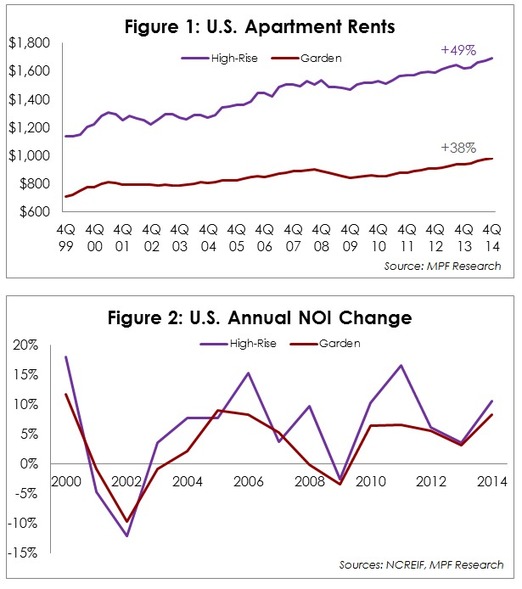
Modern times offer exciting opportunities for direct real estate investors. With properties across the spectrum realizing a significant growth trajectory, real estate investments can offer both attractive returns and diversification benefits. Specifically, apartments offer a long track record of favorable risk-adjusted returns, a higher dividend payout ratio and healthy growth of net operating income (NOI) …
Source: www.propertymanagementinsider.com
Apartments continue to offer a long track record of favorable risk-adjusted returns, a higher dividend payout ratio and healthy growth of net operating income (NOI) relative to other property types.
by admin | Jun 30, 2015 | Market Data

In most parts of the country, the condominium market is no longer broken, but a long way from booming. Developers started construction on just 28,000 new condos in 2014—compared to 151,000 back in 2006.
“The condominium market has been performing reasonably well,” says Hale. “Prices are still rising.” The median price of a condominium rose 1.9 percent over the year ending May 2015, according to NAR. The median price of $204,000 is still below the peak price of $226,000 in 2007.
The condominiums business has been held back by some of the same difficulties that have held back single-family home sales … starting with financing. Financing is difficult for many potential home-buyers, who have not established the kind of credit ratings or gathered the down payment cash that many lenders now demand. That’s especially true for condos. “Financing for condos is a little more complicated than for a single-family home. The interest rates tend to be a little different,” says Hale. “That makes them less of an ideal starter home.”
Eventually, the market for for-sale housing is likely grow back towards its historically normal levels, including condominiums. The many condos now under construction in New York and San Francisco, will test how much the condo market is ready to grow in the most expensive markets.
Source: nreionline.com
Unlike hot spots such as New York, Miami and San Francisco the condominium market is no longer broken, but a long way from booming.
The condominium business has been held back by financing which is difficult for many potential home-buyers, who have not established the kind of credit ratings or gathered the down payment cash that many lenders now demand.
How long it takes for the market to get to levels where condo sales pick up is unclear, however, it could be several years down the road.
by admin | Jun 30, 2015 | Market Data

A Palm Beach County developer will now move forward with a 234-unit apartment complex in Ybor City.
Source: www.bizjournals.com
Ybor has been underserved by the market for some time and this project should continue to reinvigorate the area.
by admin | Jun 30, 2015 | Market Data

over the last 10 years that the U.S. has lost all of the homeownership gains of the previous 20 years.
Source: www.washingtonpost.com
Over the last 10 years that the U.S. has lost all of the homeownership gains of the previous 20 years. This is having a tremendous impact on rental market for single family rental REITs and multifamily owners, operators and developers.
Some reports are predicting homeownership rates to continue to fall making this one of the most all-time unprecedented runs in the rental market the United States has ever seen.
Florida continues to be one of the most prolific leaders in the rental market with an influx of nearly 1,000 new residents migrating every day and demand for quality rental product showing continued strength.
by admin | Jun 30, 2015 | Market Data
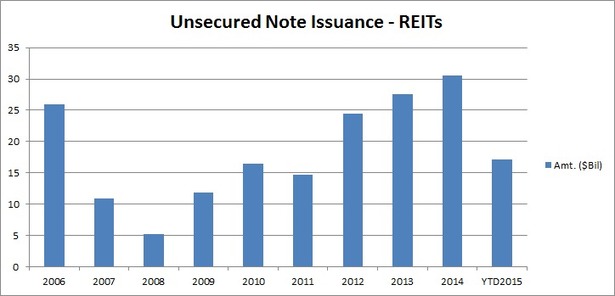
This year, real estate investment trusts (REITs) have raised $17.1 billion of capital through the sale of unsecured notes, bringing the total raised over the past two and a half years to just more than $75 billion. That is more than they raised during the previous five years.
The massive volume should not be a surprise since it comes while the yield from ten-year Treasury bonds—the benchmark against which most REITs price their bonds—has ranged from 1.66 percent to 3.04 percent during the past 30 months.
The low risk-free rates have allowed REITs to issue ten-year bonds with coupons as low as 2.75 percent during that period. That was done by Federal Realty Investment Trust, which has a Baa1 rating from Moody’s Investors Service and A- ratings from Standard & Poor’s and Fitch Ratings.
Source: urbanland.uli.org
Real Estate Investment Trusts (REITs) have raised $17.1 billion of capital through the sale of unsecured notes, bringing the total raised over the past two and a half years to just more than $75 billion. That is more than they raised during the previous five years.
REITs have faced challenges in finding suitable acquisition targets. In fact, some REITs are saying they are likely to become sellers, as opposed to buyers, because property values are so high. That could very well temper their need to borrow through the unsecured debt market.
by admin | Jun 29, 2015 | Market Data

Home automation technologies can make properties more marketable to current and potential residents.
Source: www.multihousingnews.com
There are a variety of simple upgrades owners can do, particularly in value-add communities, to add state of the art technology today’s rents are demanding at an affordable price.